
Online Safety
"With great power comes great responsibility"
At Henleaze Infant and Junior Schools we use the internet as part of pupils' learning. The sessions online are supervised by an adult and the websites the children use have been approved beforehand. Online safety is an increasingly important part of the school curriculum as a crucial life skill, so it is built into our whole Personal Development curriculum.
What do we mean by online safety?
We recognise the advantages of technology, but also need children to understand the risks, so teach them to look out for and avoid danger.
Online safety is taught in lessons through both the Computing and PSHE Curricula with additional resources from Common Sense Media and is reinforced in whole school assemblies.
We also aim to work with parents to make sure that they are well-informed about safe web usage through both information sharing via our newsletter and workshops in school.
|
|
Online safety Curriculum
Each year group has a document that maps out the content of their online safety teaching. For details, see our Computing Curriculum Page. We halos teach children about staying safe online through our PSHE curriculum and school assemblies.
Parents' Area
There are a lot of websites and resources out there aimed at parents and carers to help them keep their children safe online. These are some of the best sources.

Common Sense Media parents section has a large database with information and reviews for apps, games and films, including age ratings to help you judge suitability.
It has a huge library of handy one page guides for a variety of apps and games including information about adjusting the parental control settings.

Internet Matters has a wealth of information aimed parents and carers split into different age ranges.
It has step-by-step instructions of how to set up parental controls on all devices and apps/websites/games.

NSPCC has advice on starting conversations with your child about online safety and parental controls.
UK Safer Internet Centre
This site is an absolute MUST READ for all parents. It explains how to access security settings on your home broadband, and tells you how to manage your children's phones, gaming devices and other internet enabled equipment.
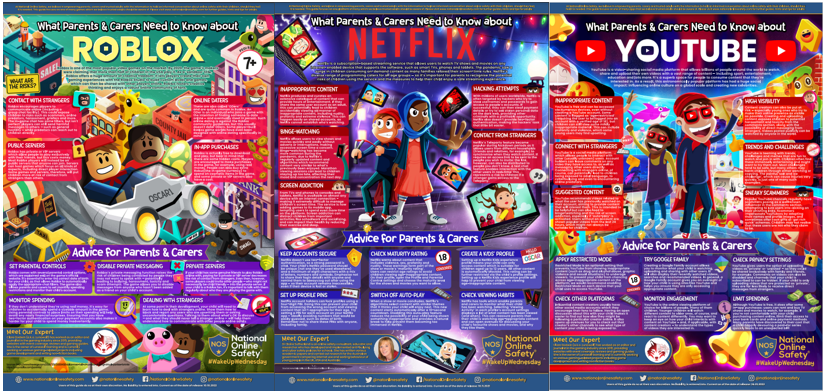
NOS has huge library of handy one page guides for a variety of apps and games including information about adjusting the parental control settings. Some examples are linked below.
Mobile phones and Smart devices in school
Mobile devices, alongside other forms of technology are changing the way and speed in which we communicate. They can provide security and reassurance however there are also associated risks. Children and young people need to understand these risks in order to help them develop appropriate strategies for keeping themselves safe.
We understand that it is a parent's choice whether their child uses a smartphone or device. However, Henleaze Junior School does not permit pupils to bring mobile devices to school in year groups below Years 5 & 6. Children in Years 5 & 6 who do need to bring a phone to school are not allowed to use them on school grounds (including the playground before or after school).
Parents/carers must give written permission for phones to be brought to school and both the pupil and parent/carer must read our Mobile Phone Policy (linked below) and sign and return the acceptable use agreement within the policy. Pupils who bring mobile phones into school must hand them in to teachers at the start of the day. Phones are stored in class boxes in the school office until the end of the school day.
Information on the effects of smartphone use in childhood can be found by Papaya in the link below.
Papaya Parents Against Phone Addiction in Young Adults
Advice on the effects of smartphones on children and adolescents.