
Infant School
Religion and Worldviews (RWV)
Our vision
At Henleaze Infant and Junior Schools, our RWV curriculum aims to inspire pupils to become curious, reflective and open-minded thinkers. The intention is for pupils to develop the confidence to ask meaningful questions, explore a range of beliefs and worldviews and reflect on their own values and those of others.
The scheme aims to raise awareness of how religion and worldviews influence individual lives, communities and cultures over time. Its goal is to encourage pupils to become respectful and thoughtful citizens who can engage with diversity and contribute positively to a pluralistic society.
Our Curriculum
At Henleaze Infant and Junior Schools we follow the Kapow curriculum for RWV. We have selected it because it is cumulative, coherent and connected.
The curriculum takes a religion and worldviews approach, which recognises that everyone has a worldview, shaped by their beliefs, values, experiences and communities. A worldview may be religious or non-religious, organised or personal and influences how a person understands and responds to the world.
Rather than studying each worldview in isolation, pupils explore a range of religious and non-religious perspectives relevant to the unit. This helps them identify similarities and differences, understand diversity within and between worldviews and reflect on their own developing worldview with curiosity, respect and openness.
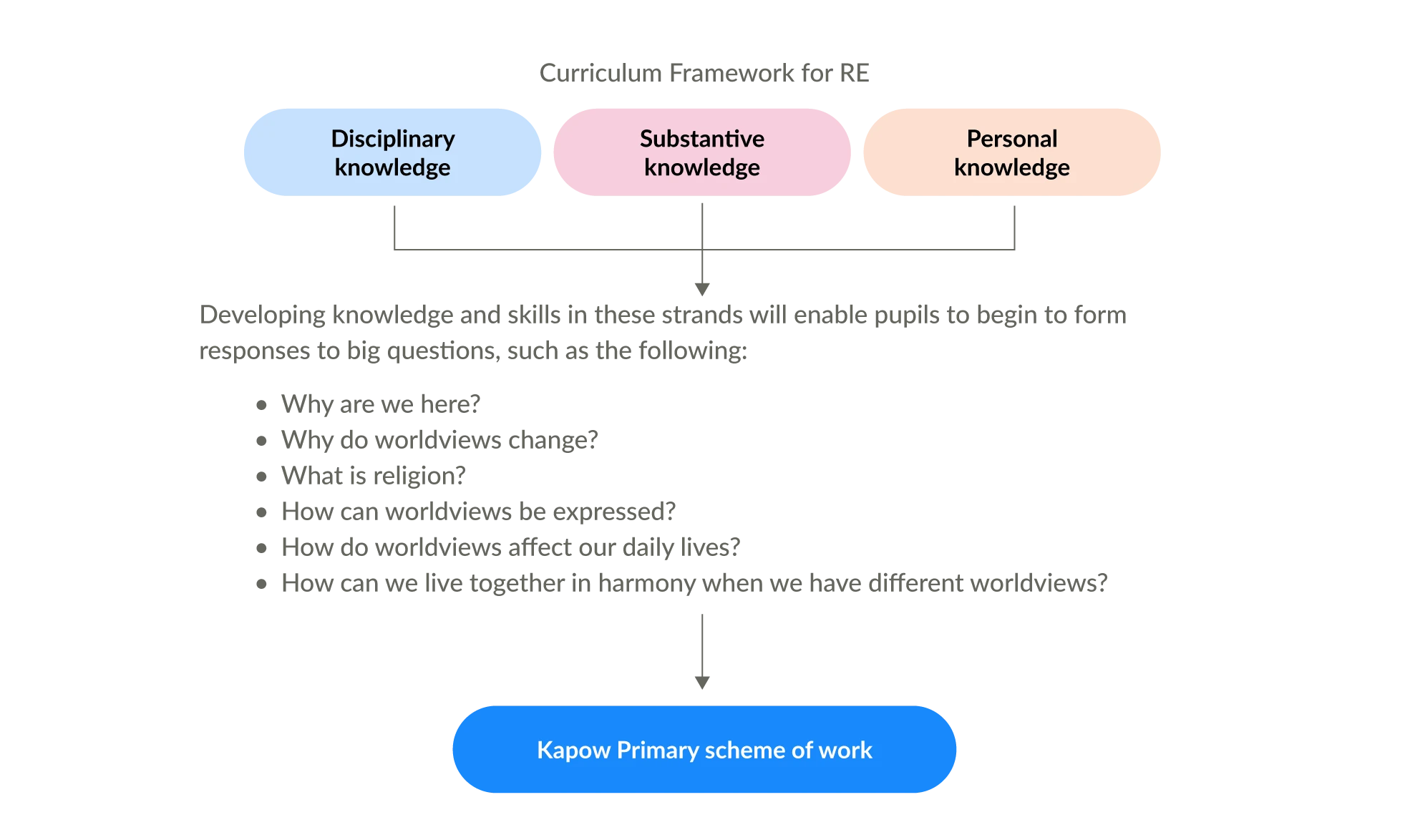
The R&W curriculum is organised under the following three key strands:
- Substantive knowledge.
- Disciplinary knowledge.
- Personal knowledge.
Kapow Primary’s RWV curriculum has been planned with these strands running through each unit, ensuring balanced coverage of the different aspects of R&W and opportunities to develop both substantive and disciplinary understanding, alongside personal reflection.
The RWV curriculum allows pupils to apply disciplinary knowledge through the enquiry cycle.
By revisiting the cycle in every unit, pupils learn to think and work like scholars of religion: asking open-ended questions, investigating evidence, interpreting meaning, evaluating claims, applying insights and expressing reasoned conclusions.
Substantive knowledge builds pupils’ factual understanding of the key concepts that underpin both religions and non-religious worldviews. It consists of two elements: conceptual knowledge and worldview-related knowledge.
Conceptual knowledge statements show how pupils’ knowledge builds in their understanding of:
- Beliefs.
- Wisdom and morality.
- Practices.
- Community and belonging.
Worldview-related knowledge statements show the knowledge covered within the units that is relevant to a specific religion or worldview.
Personal knowledge enables pupils to think about their own positionality – recognising that people approach learning from a particular worldview shaped by family, culture and experience.
Additionally, it enables them to reflect on how their perspective may influence their learning and how their own worldview compares to those of others.
Impact
Each year group has clear cumulative end goals – these are identified for teachers. Formative assessment is embedded including: questioning, observation, discussion and peer interaction, lesson pauses, retrieval practice (quizzes), use of success criteria and short reflections (knowledge catchers) enabling pupils to consolidate learning and teachers to gauge understanding.
Subject overview
| Reception | Year 1 | Year 2 | Year 3 | Year 4 | Year 5 | Year 6 | |
| Terms 1 and 2 | Time to Celebrate |
How did the world begin? What do some people believe God looks like? |
Why do we need to give thanks? | What makes us human? |
Are all religions equal? What makes some texts sacred? |
Why do some people have to stand up for what they believe in? | Why does religion look different around the world? |
| Terms 3 and 4 |
What makes us special?
|
Why should we care for the world? Why should we care for others? |
What is a prophet? |
Where do our morals come from? What happens if we do wrong? |
Just how important are our beliefs? Who was Jesus really? |
Why doesn't Christianity always look the same? | Why is it better to be there in person? |
| Terms 5 and 6 | Why are some places special? | How do we know that new babies are special? |
How do some people talk to God? Where do some people talk to God? |
Is scripture central to religion? Why is water symbolic? Why is fire used ceremonially? |
Does the language of scripture matter? | What happens when we die? | Why is there suffering? |